
Red light and near-infrared light appear together on many home wellness devices, which makes it easy to assume they mean the same thing. They do not. They occupy different parts of the light spectrum, and the distinction matters when you are reading specifications, comparing products or deciding what questions to ask before buying.
This guide explains red light vs near-infrared light therapy without turning a wavelength number into a promise. You will learn why one kind of light is visible and the other is not, why brightness is not a reliable measure of performance, and why the design and instructions of a particular device matter just as much as its headline features.
If you are exploring home devices for the first time, start with understanding the terminology rather than searching for the highest number. A useful product comparison should help you understand what you are buying, how it fits your routine, and what evidence supports any advertised outcome.
In this guide
- The quick answer
- What is red light?
- What is near-infrared light?
- How to read wavelength specifications
- Understanding research and product claims
- Why device design matters
- How to compare products fairly
- Planning a practical home routine
- Frequently asked questions
Red light vs near-infrared: the quick answer
The simplest difference is visibility. Red light is part of the visible spectrum, so it appears red to human eyes. Near-infrared light sits just beyond the red end of the visible spectrum and is generally invisible to us. A device can therefore emit near-infrared light without producing a visible glow from those particular emitters.
Some products combine red and near-infrared light. That combination does not mean the two types become interchangeable, and it does not establish that a product is suitable for every goal. It means the product is designed to emit more than one part of the spectrum. You still need to look at the complete specification and the manufacturer's instructions.
Neither the amount of visible red glow nor the number of settings can tell you, on its own, how well a device will perform. Product-specific evidence, appropriate use and clear operating guidance are more useful than the impression a device makes in a photograph.
What is red light?
Red light is visible light at the long-wavelength end of the spectrum we can see. In a light therapy product, LEDs are used to produce a selected band of light. Product descriptions usually identify that band using a wavelength measured in nanometres, written as nm.
For someone shopping at home, the important point is that the red colour describes part of the light being emitted. It does not describe the entire performance of the product. Two devices can both look red while differing in their output, the area they cover, the distance at which they are intended to be used and the instructions supplied with them.
Red light is also not the same thing as an ordinary room lamp with a red shade. A coloured appearance alone does not tell you whether a product has been designed or evaluated for a particular application. The relevant information should come from the device specification, not simply from its colour.
Be equally cautious about photographs. Exposure settings, reflections and editing can make one product appear much brighter than another. A dramatic red photograph may be useful for showing how a device looks, but it is not a measurement of the light reaching your skin during intended use.
What is near-infrared light?
Near-infrared, often shortened to NIR, refers to the region just beyond visible red light. Because your eyes generally cannot see it, the absence of a visible glow is not a dependable way to decide whether a near-infrared emitter is operating. Use the status indicators and checks described in the product manual instead.
This invisible quality can create confusion when a combined device is switched on. Some emitters may look bright red while others appear dark. That observation alone cannot diagnose a fault. Equally, it cannot confirm correct operation. If you are unsure, stop guessing and contact the seller or manufacturer with the model details.
Near-infrared is a broad category, not one universal setting. Different products may use different wavelengths within that category. They can also differ in output and construction. A label that says NIR therefore gives you a starting point for questions rather than a complete description of the product.
Do not judge near-infrared output by how warm something feels. Sensation is not a calibrated measurement, and a device should never be pushed beyond its instructions simply because you cannot see its light. Invisible does not mean inactive, and it does not mean that unlimited exposure is appropriate.
How to read wavelength specifications without getting lost
A wavelength number tells you something about the type of light a device is designed to emit. It does not tell you everything about the amount of light delivered, the distribution of that light or the conditions in which it has been studied. Treat wavelength as one part of a specification, not a shortcut to a guaranteed result.
When comparing products, write down the listed wavelengths exactly as they appear. Then check whether the manufacturer explains how those wavelengths are used. Can they be selected independently? Are they always emitted together? Does the recommended session change between modes? These practical details can matter more to your everyday use than a long list of technical terms.
It is also helpful to separate wavelength from power. Electrical power consumed by a device is not automatically the same as optical output reaching a treatment area. Likewise, an output measurement taken at one distance cannot simply be applied to every other distance. Look for the measurement conditions, not just the biggest figure.
If a specification uses unfamiliar language, ask for a plain-English explanation. A useful answer should clarify what was measured, where it was measured and how the figure relates to the instructions. You should not need to invent your own operating routine from a collection of disconnected numbers.
What does the difference mean for research and product claims?
You may encounter the term photobiomodulation when reading about red and near-infrared light. Research in this area examines light under particular conditions. Those conditions can include the wavelength, output, exposure, treatment schedule, device design and the population being studied. Removing those details can make a research finding sound much broader than it actually is.
A study about one application is not automatically evidence for another. A study involving a specific clinical device also does not automatically establish the same outcome for every consumer device with a similar wavelength printed on the box. Similar terminology is not the same as an identical intervention.
For that reason, be wary of claims that a single wavelength fixes every concern or that adding near-infrared makes any product universally better. A more useful question is whether the evidence relates to the particular outcome, device and use conditions being discussed. If the connection is not explained, ask for it.
This article is an educational guide to terminology and product comparison, not a clinical evidence review or personalised treatment advice. If your aim is to manage a symptom or medical condition, discuss that goal with a qualified healthcare professional. Do not use a home wellness purchase as a reason to postpone assessment or replace prescribed care.
Does near-infrared always mean deeper or better?
You will often see red and near-infrared described using a simple surface-versus-depth comparison. It can be a useful introduction, but it is not a reliable buying rule on its own. How light interacts with tissue depends on more than a category name, and a claim about depth is not itself evidence of a meaningful benefit.
In particular, reaching a different depth does not establish that a device achieves the result you want. The application, dose and evidence still matter. Marketing that jumps directly from a wavelength to a guaranteed outcome leaves out the questions that should help you make an informed decision.
Avoid ranking products as good, better and best purely by the presence of near-infrared. Instead, compare suitability for the intended area, clarity of instructions, practical comfort and the quality of information available. More features can add flexibility, but they can also add complexity that you may not need.
Why device design matters alongside the light spectrum
A mask and a panel may both advertise red and near-infrared light, yet they are different products to live with. Their format affects positioning, storage, coverage and how easily you can follow the recommended routine. The best format for you is not necessarily the one with the longest specification sheet.
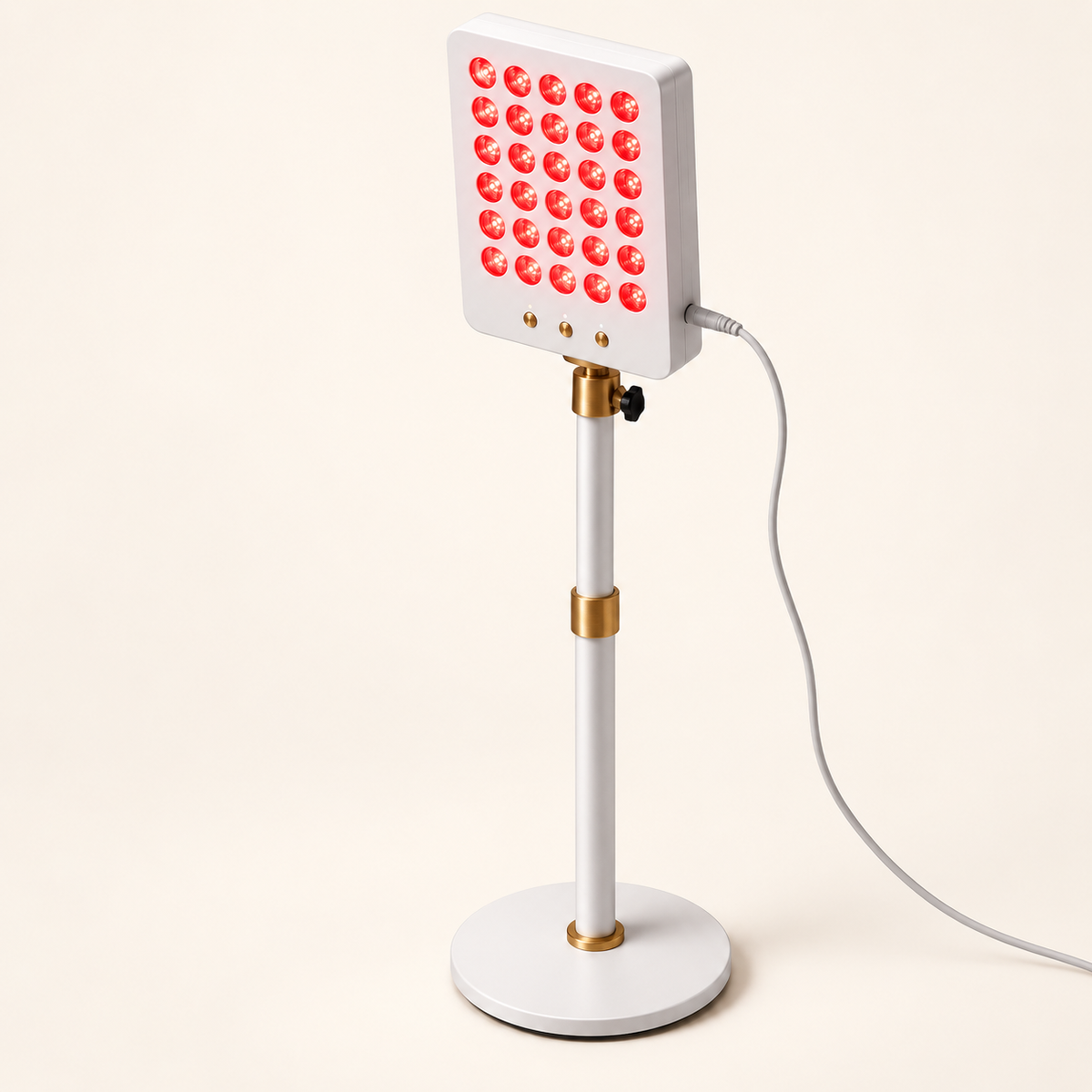
A face-focused wearable format may appeal if you prefer a device shaped for that area. A separate panel introduces different considerations, such as placement and the operating distance stated in its manual. Neither format should be used according to assumptions borrowed from the other.
For a starting point within the Kroma range, explore the Kroma Glow Mask red and near-infrared face mask and the Kroma Glow Pro red and near-infrared panel. Read each product's current details and instructions rather than assuming that their shared light categories make them equivalent.
Think about your available space as well. A device that requires a setup you cannot comfortably repeat may be a poor fit, even if its features initially sound appealing. Practical suitability is not a minor detail: it is part of choosing something you can use as directed without improvising.
How to compare red and near-infrared devices fairly
Start with one clear purpose
Write down what you are actually shopping for before comparing models. Are you looking for a face-focused format, a panel setup or a general addition to your home wellness routine? Keeping the purpose narrow makes it easier to notice when a product description answers your question and when it simply lists features.
Look for complete instructions
Check for guidance on positioning, session duration, frequency, modes and any required eye protection. If those details are missing, request them before buying. A general article cannot safely fill the gaps in a particular product's manual, and another brand's routine should not be used as a substitute.
Compare measurements on matching terms
If you are comparing output figures, check the distance and conditions behind each one. Numbers taken in different ways may not be directly comparable. Avoid choosing solely by LED count, electrical wattage or apparent brightness, because none of those alone gives you the whole picture.
Read support and care information
Consider whether you can easily obtain the manual, ask a technical question and understand the cleaning and storage requirements. These details are useful throughout ownership. A clear answer before purchase can be more valuable than another marketing phrase about advanced technology.
Separate facts from predictions
A stated wavelength or physical dimension is a different kind of information from a predicted personal outcome. Keep the two separate in your notes. Product facts can help you compare suitability, while outcome claims need relevant evidence and should never be treated as a guarantee for an individual user.
Building a practical home routine
Begin with the instructions for the exact model you own. Do not combine timing advice from a mask, a panel and an online discussion into a new routine. Differences between products can make that approach misleading, even when they all use the words red light or near-infrared.
Set up the space so that following the guidance is straightforward. Make sure the device can be positioned securely, that any required accessories are available and that you can stop the session easily. Avoid improvised arrangements that change the intended distance or encourage you to fall asleep during use.
Do not increase exposure simply because near-infrared is invisible or because visible red light feels familiar. Longer sessions and more frequent use are not automatically better. Keep within the manufacturer's limits, and seek advice if the instructions leave you uncertain about what is appropriate.
If you want to keep notes, record the model, selected mode and whether you followed the recommended setup. Keep observations modest and objective. Personal notes may help you discuss questions, but they do not establish that a device caused a change, especially if you are also changing skincare, exercise, sleep or other habits.
Safety questions to ask before using a device
Read the warnings before the first session, not after an unexpected reaction. Pay particular attention to eye guidance, intended users and any circumstances in which use is not recommended. Do not assume that instructions supplied with a different light product apply to yours.
If you take medication, use products that may affect light sensitivity, have an eye condition or are unsure whether light exposure is suitable for you, ask an appropriately qualified healthcare professional before starting. Bring the actual device information so the discussion is about the product rather than a vague description.
Stop using the device if you experience discomfort or an unexpected reaction, and obtain appropriate advice. Do not treat discomfort as proof that something is working. Avoid using a device in ways the manufacturer has not intended, including improvised positioning close to the eyes or combining it with unapproved equipment.
Frequently asked questions
Can a device have both red and near-infrared light?
Yes. Some devices combine the two, while others offer different arrangements or selectable modes. Check the current specification for the individual model. The presence of both categories does not tell you whether they operate independently, what session is recommended or which claims have evidence behind them.
Why do some LEDs look as if they are switched off?
Near-infrared is generally invisible to human eyes, so appearance alone is not enough to diagnose a problem. Follow the checks in the manual and contact support if needed. Do not stare into emitters, bypass safety guidance or use a camera experiment as a substitute for the manufacturer's advice.
Is red light the same as ultraviolet light?
No. Red light, near-infrared and ultraviolet refer to different regions of the electromagnetic spectrum. However, identifying one region does not answer every safety question about a finished product. Read the complete specification and warnings rather than assuming that one label establishes suitability for everyone.
Should I choose the brightest-looking device?
No. Visible brightness is not a complete performance measurement, particularly when near-infrared is part of the specification. Compare relevant product information, measurement conditions and intended use. A photograph or a strong red glow cannot show you how well a device fits your needs.
Does more near-infrared mean faster results?
That conclusion cannot be drawn from the feature alone. Any outcome claim needs evidence relevant to the particular application and conditions. Do not increase session length or frequency in pursuit of faster changes. Use the device as directed and keep expectations grounded in product-specific information.
Can I use a panel exactly like a mask?
Do not assume so. Their format, positioning and instructions may differ. Use the manual supplied for your particular product, including guidance on distance and eyes. If you change device types, treat that as a new setup to learn rather than simply carrying over your old routine.
Where should I start if I am still unsure?
Start with your intended area, preferred format and the instructions you would need to follow. Then compare the current Kroma Glow Pro panel information with the Kroma Glow Mask product details. If you need help interpreting a specification, ask before purchasing rather than relying on a headline.
The takeaway: understand the light, then assess the whole device
Red light and near-infrared are related but distinct parts of the spectrum. The visible-versus-invisible difference is straightforward; choosing a product requires a wider view. Wavelength, output information, intended positioning, practical format and clear instructions all deserve attention.
A thoughtful comparison does not ask which light category wins in every situation. It asks which product is appropriate for its intended use, what the evidence actually supports and whether you can follow the guidance comfortably. That is a stronger starting point than chasing brightness, bigger numbers or promises of instant change.
Explore Kroma's linked product pages when you are ready to compare formats, and keep the manual at the centre of your decision. Understanding the terminology should make shopping clearer, not pressure you into a more complicated routine.


Leave a comment
This site is protected by hCaptcha and the hCaptcha Privacy Policy and Terms of Service apply.