
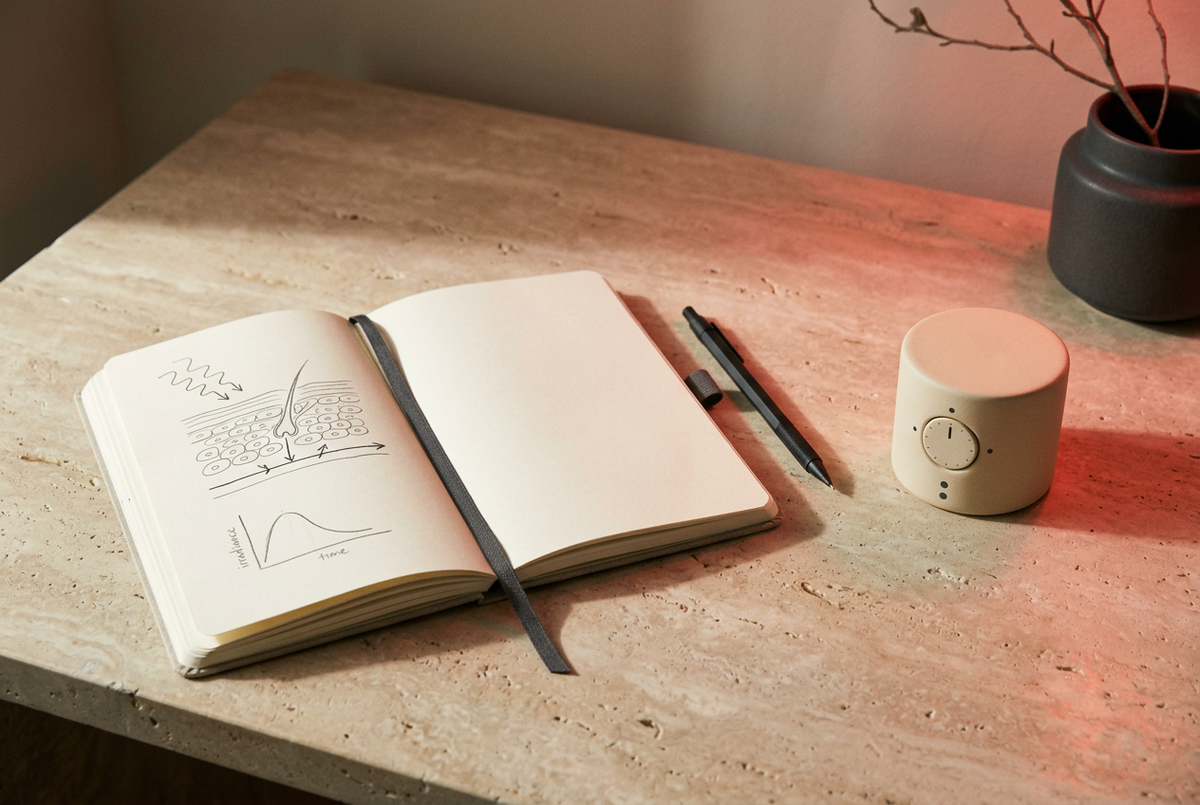
Comparing red light therapy devices can feel straightforward until the specifications appear. One product lists watts, another lists milliwatts per square centimetre, and a third talks about joules. Each number describes something different. Without that context, it is easy to compare figures that were never meant to be compared.
This guide explains red light therapy irradiance and dose in plain English. You will learn what the units mean, how distance and time affect the figures, which questions to ask about a measurement, and why a larger number is not automatically a better choice. The aim is to help you read specifications thoughtfully, not to create a personalised treatment plan.
Start with the instructions supplied with your particular device. The calculations below are educational examples, not recommended doses, distances or session lengths. If you are considering light therapy for a medical concern, speak to an appropriately qualified healthcare professional rather than using a shopping specification as clinical advice.
In this guide
- What irradiance means
- Watts, wavelengths and coverage
- How light dose is calculated
- Why distance and position matter
- How to compare device specifications
- Building a repeatable home routine
- Frequently asked questions
What is red light therapy irradiance?
Irradiance describes the rate at which radiant power arrives at a surface, divided by the area of that surface. In home red light therapy discussions, you will often see it written as mW/cm²: milliwatts per square centimetre. It is a measurement of incoming light power per area, not a direct measurement of a health outcome.
Imagine placing a measurement sensor at a particular position in front of a panel. The reading describes the light reaching that sensor under those conditions. Move the sensor, change its angle, select a different operating mode or use another measurement method, and the result may change. A useful irradiance figure therefore needs context.
The distinction matters because a number printed beside a device is not necessarily the number reaching every part of your body during use. A reading taken at the centre of the beam may differ from readings near its edges. Your face, shoulder or leg is also not a perfectly flat laboratory surface.
Think of irradiance as one part of a description. It can help explain a device's light output when it is measured and reported clearly. On its own, however, it cannot tell you whether that device is appropriate for your goal, how comfortable it will be to use, or what results you should expect.
Watts, wavelengths and irradiance are different things
Electrical watts are not light delivered to your skin
A wattage figure may describe electrical consumption, a nominal rating associated with the LEDs, or measured optical output. Those are different quantities. Unless the manufacturer explains exactly what the number represents, comparing two headline wattages can be misleading.
Electrical input includes energy used by the device as a whole. It should not be treated as a measurement of light arriving at a specific distance. A product with a larger electrical rating does not automatically deliver a more useful session, just as a larger appliance does not automatically suit every room.
When reading a listing, ask whether the figure refers to electricity drawn from the socket or light output measured under stated conditions. If that is unclear, seek clarification rather than filling the gap with an assumption. Clear definitions are more useful than impressive-looking numbers.
Wavelength describes the light, not the dose
Wavelength is commonly expressed in nanometres, written as nm. It describes a property of the emitted light, rather than how much light reaches a surface or how long you use the device. Red and near-infrared are not interchangeable labels for electrical power or session intensity.
A wavelength specification and an irradiance specification answer different questions. One helps identify the light being emitted; the other describes incoming power per area under measurement conditions. Neither should be used alone to predict a particular result. For more background, read our guide to red light versus near-infrared light therapy.
Coverage adds another practical dimension
A small area with a high reading and a wider area with a lower reading are not the same experience. Consider the area you want to expose and whether the stated measurement represents that whole area. A single central reading cannot describe the uniformity of an entire light field.
Device format also changes how you use it. A panel positioned at a distance is not equivalent to a wearable device with a defined fit. Choose a format that works with its intended instructions and your available space, rather than trying to convert every product into one universal power ranking.
What does light dose mean?
In this context, people often use the word dose to mean radiant exposure: energy arriving per unit area over time. It is commonly expressed as joules per square centimetre, or J/cm². This is different from irradiance, which describes a rate rather than an accumulated amount.
Under a simplified assumption of constant irradiance, the relationship is:
Radiant exposure in J/cm² = irradiance in W/cm² × time in seconds.
Because specifications often use milliwatts, remember that 1,000 milliwatts equals one watt. Divide an irradiance figure expressed in mW/cm² by 1,000 before multiplying it by seconds. Keeping track of those units avoids a thousand-fold calculation error.
A worked example, not a recommended session
Suppose a hypothetical sensor receives a steady 20 mW/cm² for 100 seconds. First convert 20 mW/cm² to 0.020 W/cm². Multiplying 0.020 by 100 gives 2 J/cm² at that measured surface. The example exists only to demonstrate the arithmetic.
It does not establish that 2 J/cm² is suitable for your skin, your goal or your device. It also does not establish how much light is absorbed by a particular tissue. The calculation begins with a measurement at a surface and should not be mistaken for a measurement inside the body.
If the starting irradiance is uncertain, the calculated exposure is uncertain too. A precise-looking answer from a calculator does not improve an unclear input. That is why understanding the conditions behind a specification is more useful than copying a formula into an ambitious routine.
Equal calculated exposure does not guarantee equal effects
Two hypothetical sessions can produce the same multiplication result while differing in wavelength, exposure pattern, geometry and other conditions. It is not safe to assume they are clinically equivalent simply because the final J/cm² figure matches.
Similarly, a published research protocol cannot automatically be transferred to any home device. The equipment, population, intended use and method may differ. Treat a calculation as a way to understand terminology, not as permission to replace the instructions supplied with your product.
Why distance changes the comparison
Distance matters because the light reaching a surface depends on the device's optics and geometry. A quoted reading at one position may not describe another. If two products report irradiance at different distances, their headline values are not directly like-for-like.
Do not assume a simple rule will accurately predict every panel's output as you move backwards or forwards. Arrays of LEDs, lenses and nearby measurement positions can make the distribution more complicated than a textbook point-source example. Use measurements and instructions that apply to the actual product.
Closer is not automatically the correct position. A device may be designed around a specific working distance for coverage, comfort or other operating requirements. Standing closer solely to increase a number can take you away from the conditions described in its instructions.
For a practical discussion of setup, see how far away to sit from a red light therapy device. Keep the manufacturer's positioning guidance as your starting point, and do not substitute a general blog example for product-specific directions.
Angle, placement and consistency matter too
Changing the angle between a surface and the incoming light changes the exposure geometry. Turning sideways, leaning away or moving a panel can also change which areas are illuminated. This is one reason real-world use is not captured by a single central specification.
For a more repeatable setup, use a stable position, follow the recommended orientation and avoid unnecessary changes between sessions. Repeatability does not promise a result, but it makes your own record more meaningful than a routine that changes distance, mode and duration every time.
How to compare red light therapy specifications sensibly
Ask where the reading was taken
A useful specification should explain the measurement distance. Ideally, it should also distinguish between a central peak reading and an average across a stated area. Without that information, you may be comparing a narrow hotspot with a broader measurement.
Look for a clear description rather than assuming the most prominent number represents the whole treatment area. If the listing leaves out the conditions, ask the supplier. Missing information is a reason to ask a better question, not a reason to invent the answer.
Ask which operating mode was measured
If a device offers different light modes, a reading from one configuration may not represent another. A figure measured with several channels active should not automatically be applied to a session using only one of them. Read the specification alongside the operating instructions.
Pulsed modes can introduce another distinction between peak and time-averaged output. Without knowing how the device operates and how its output was measured, you should not use a peak figure as though it were a continuous average. Seek a product-specific explanation if you need one.
Ask how the measurement was made
Measurement equipment, calibration and method can affect reported values. That makes transparency valuable. A number supported by a clearly described method is easier to interpret than a large claim with no explanation of the instrument or conditions behind it.
You do not need to become an optical engineer to shop thoughtfully. Simply recognise that apparent precision is not the same thing as complete information. If two manufacturers use different methods, acknowledge that limitation instead of declaring a winner from the headline figures alone.
Compare usability as well as specifications
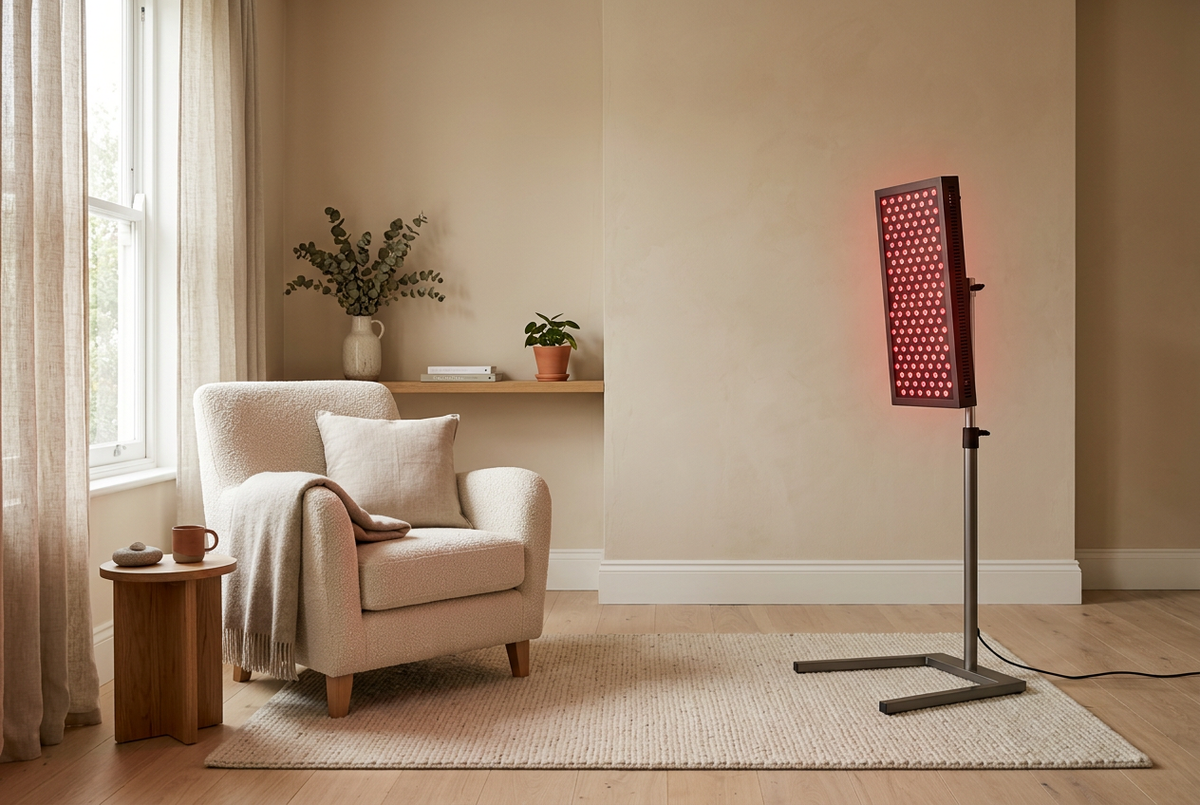
Consider available space, setup time, the intended area of use and how the device fits your daily life. A product that is awkward to position may not suit you even if its technical listing looks attractive. Practical details belong in the buying decision alongside output information.
For panel options, you can explore the Kroma Glow Pro red and near-infrared light therapy panel and the Kroma Radiance Pro full-body panel. Check each product's current information and supplied instructions. This guide does not assign either device a measured irradiance or recommend a universal exposure.
Why more is not automatically better
It is tempting to interpret light exposure as a simple ladder: more power, more minutes, better results. That is not a reliable basis for a routine. A specification does not establish that increasing exposure beyond the manufacturer's guidance will improve your experience or outcome.
More time can also mean a less convenient routine, making it harder to maintain a consistent approach. Resist the urge to compensate for missed sessions with longer ones or to combine several devices on the same area without appropriate guidance. Doubling up is not a shortcut justified by a dose formula.
Do not use heat, tingling or visible brightness as a home measurement of an appropriate dose. A sensation does not tell you the irradiance at your skin, and the brightness perceived by your eyes is not a substitute for an optical measurement. Follow the device's safety and eye-protection instructions.
Building a repeatable home routine
Start with the device, not an online calculator
Read the supplied instructions before deciding how often or how long to use your device. Check its intended use, recommended position, operating modes and any warnings. Where instructions are unclear, contact the supplier rather than extrapolating from an unrelated product or a social media routine.
If you take medicines that may affect light sensitivity, have an eye condition, are pregnant or have another relevant health concern, seek advice from an appropriate healthcare professional before use. A general educational article cannot assess personal suitability or replace professional guidance.
Keep a simple record
A short record can include the date, device, operating mode, duration and position used. Note any discomfort and any other changes to your routine. This makes it easier to describe your experience accurately if you later need support or professional advice.
For skin-related goals, remember that skincare changes, lighting and photography can alter how progress appears. Avoid interpreting every day-to-day difference as an effect of the device. Our guide to realistic red light therapy timelines discusses why expectations need context.
Keep the setup in good condition
Use the device as intended and check it for damage before use. Follow the manufacturer's cleaning and storage directions, including any instructions about disconnecting power and avoiding moisture. Do not open or modify a device to try to increase its output.
For general care considerations, read how to clean and store a red light therapy device. Product-specific instructions take priority over general housekeeping suggestions, especially where electrical parts or contact surfaces are involved.
Frequently asked questions
What is a good irradiance for red light therapy?
There is no single figure this guide can recommend for every product, person and intended use. A meaningful answer requires context, including wavelength, measurement method, distance, duration and the device's instructions. Be cautious of advice that gives one universal number without explaining those conditions.
Is a higher-wattage panel always stronger?
Not in a way you can conclude from the electrical figure alone. Electrical consumption, nominal LED ratings and measured optical output describe different things. To understand light arriving at a surface, you need the relevant measurement conditions rather than just a wattage label.
Can I calculate dose from session time alone?
No. In the simplified calculation, you also need irradiance at the relevant surface, and that input must apply to the actual conditions. Time alone does not tell you radiant exposure. A calculated surface exposure also does not establish absorption or a clinical outcome.
Can I copy a session from another brand?
Do not assume another product's routine applies to yours. Devices differ in design, modes, positioning and intended use. Follow your own manufacturer's guidance and seek clarification when needed, rather than copying a session length simply because both devices emit red light.
Should I buy a light meter?
A consumer meter is not automatically suitable for every wavelength or measurement task. Without appropriate equipment and method, a reading can create false confidence. For most shoppers, asking for clear manufacturer data and following the supplied instructions is more useful than making unsupported home measurements.
Does an irradiance figure prove a device will work?
No. Irradiance describes incoming power per area under particular conditions. It does not, by itself, establish effectiveness for a specific concern. Evaluate any outcome claims separately from output specifications and seek qualified advice for questions about treating a health condition.
The takeaway: understand the numbers, then keep it practical
Red light therapy irradiance and dose become easier to understand when you separate the units. Watts may refer to electrical input or optical output. Nanometres describe wavelength. Milliwatts per square centimetre describe incoming power per area. Joules per square centimetre describe energy per area accumulated over time.
The important next step is not to chase the largest figure. Look for transparent measurements, compare like with like, choose a format that suits your space, and use your device according to its own instructions. Those habits support a more informed purchase and a more repeatable routine without turning a specification sheet into a promise.
This article is general educational information, not medical advice or a personalised treatment protocol. The numerical example is hypothetical. For health concerns or questions about individual suitability, speak to an appropriately qualified healthcare professional.

Leave a comment
This site is protected by hCaptcha and the hCaptcha Privacy Policy and Terms of Service apply.