
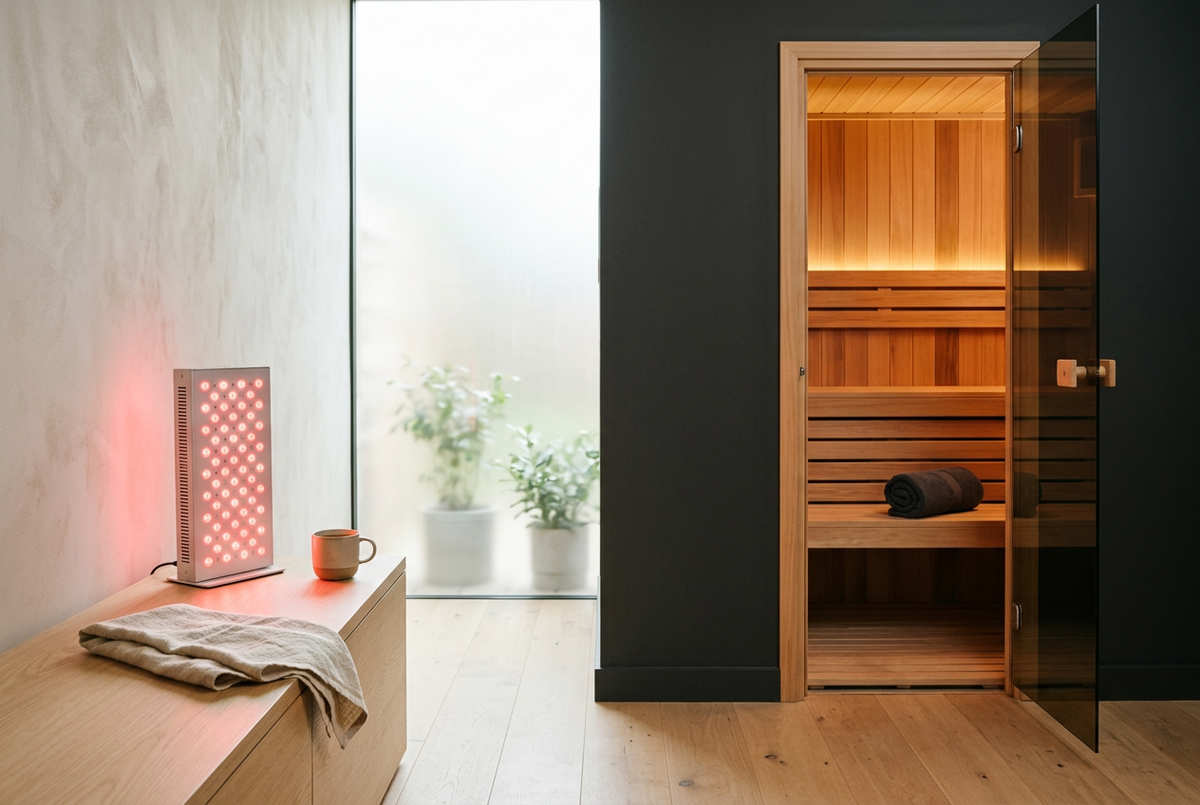
When comparing red light therapy vs infrared sauna for home use, it is easy to assume that both options do essentially the same thing. Both involve light-related terminology, both appear in wellness spaces, and both are frequently photographed with a red or amber glow. Yet those similarities can hide an important distinction: a red light therapy device is not simply a small sauna, and an infrared sauna is not automatically a red light therapy system.
The most useful starting point is to separate light exposure from deliberate heating. Red light therapy, often discussed under the scientific term photobiomodulation, uses particular light wavelengths and exposure settings. An infrared sauna uses infrared energy to create a heat experience. Their purposes, specifications and day-to-day routines need to be assessed separately.
This guide explains the differences without treating either option as a miracle solution. You will learn what the terminology means, which home setup questions matter, how to compare running costs, and why research about one type of equipment cannot simply be applied to another. It is an educational comparison, not personal medical advice or a recommendation to treat a health condition.
Is an infrared sauna the same as red light therapy?
No. An infrared sauna and a red light therapy device are different categories of equipment, even though the word infrared can appear in descriptions of both. The shared terminology describes part of the electromagnetic spectrum; it does not establish that two devices deliver the same exposure or produce the same effects.
A typical infrared sauna is designed to warm the body and create a sauna environment. Cleveland Clinic explains that infrared saunas use lamps or panels to generate radiant heat, warming the body more directly than a traditional sauna that mainly heats the surrounding air. Heat is central to that experience, not an accidental extra.
Photobiomodulation is generally discussed in terms of red and near-infrared light, with exposure defined by parameters such as wavelength, output and duration. It is not primarily intended to reproduce a whole-body sauna heat session. A panel can feel warm during operation, but warmth alone does not tell you whether its light output is appropriate or effective.
Put simply, ask what the equipment is designed to deliver. Is the primary experience a heated cabin, or is it controlled exposure to specified light? That question is more helpful than judging a product by the colour shown in an advertising photograph.
Why red light, near-infrared and far-infrared are easy to confuse
Red light is visible. Near-infrared light sits beyond visible red and is not normally visible to the human eye. Far-infrared refers to a different part of the infrared spectrum. These labels describe different wavelength regions rather than interchangeable versions of one treatment.
Some red light therapy devices combine visible red LEDs with near-infrared LEDs. Consequently, a device can include an infrared component without being a sauna. Conversely, equipment described as infrared may be designed for heating rather than photobiomodulation. The word alone is not enough to identify the intended use.
There are also products marketed as full-spectrum saunas or combined light-and-heat systems. Their features vary. Do not assume that a combined product has a particular wavelength, verified optical output, or independently controllable light function unless the documentation actually supplies that information.
For a closer explanation of light terminology, read our guide to red light vs near-infrared light therapy. Understanding that distinction makes it much easier to interpret specifications without getting distracted by broad wellness language.
How red light therapy is described in research
Photobiomodulation research examines how selected light exposures interact with biological processes. A scientific overview published in the Journal of the American Academy of Dermatology describes red and near-infrared light, cellular light absorption, and the importance of treatment parameters. That is a more precise framework than saying that any red glow has a therapeutic effect.
Importantly, a research result belongs to the conditions studied. The equipment, exposure, participants and measured outcome all matter. A study involving a professional device cannot automatically establish what a different home device will do. Likewise, a result for one skin-related outcome does not prove a claim about every other wellness goal.
Cleveland Clinic notes that red light therapy research remains ongoing and that many discussions draw on small studies. This is a reason to read claims carefully, not to assume that every claim is false or that every advertised benefit is established. The practical question is whether a specific statement is supported by relevant evidence.
For home users, this means prioritising clear instructions and realistic expectations. There is no universal session schedule that can be copied from a study, a social-media video or an unrelated device and applied confidently to every panel, mask or mat.
How an infrared sauna differs in everyday use
An infrared sauna is built around a thermal experience. Depending on its design, it may be a cabin, enclosure or another format intended to provide heat. A user commonly needs to think about the heated environment, the session itself, and the practical steps before and afterwards.
Cleveland Clinic distinguishes infrared heating from traditional sauna heating, while also explaining that both can make a person sweat. This difference does not mean that infrared heat is suitable for everyone or that a lower advertised temperature removes the need for sensible precautions.
For comparison shopping, the key issue is not which option sounds more advanced. It is whether you actually want a heat-based routine. Someone who enjoys sitting in a warm enclosed space is considering a different experience from someone who wants to position a light panel near a particular area while remaining in an ordinary room.
Do not use sweating as a test of red light therapy performance. Equally, do not expect the colour of a sauna lamp to demonstrate that a cabin delivers a specified photobiomodulation exposure. Those are different measurements answering different questions.
Red light therapy vs infrared sauna for a small home
Start with the space you can genuinely keep available. A compact panel may fit on an appropriate stable surface, but you still need room to maintain the manufacturer’s recommended distance, prevent tipping and keep cables clear. A larger panel can require dedicated floor space, a suitable stand or an approved mounting arrangement.
A sauna cabin raises a different set of practical questions. Check the complete installed dimensions, the space needed for access, ventilation requirements and any electrical or assembly requirements. The footprint in a product photograph may not show the clearance needed around the actual installation.
Portable and foldable sauna formats also need to be assessed individually. Storage size is only part of the picture. Consider setup time, cooling, drying, cleaning and where the equipment will sit while it is being used. Something that folds away is not necessarily effortless to use every day.
The best home choice is often the one that fits an ordinary week rather than an imagined perfect routine. Measure your space before ordering, read the manual where available, and make sure other household members can still use the room comfortably.
Which option is easier to fit into a busy routine?
Compare the complete routine rather than the timer setting alone. With a red light device, you may need to position the equipment, prepare the treatment area according to the instructions, use the recommended eye protection where required, complete the session and put the device away safely.
With an infrared sauna, the practical routine may include preparation, any warm-up specified by the manufacturer, the heated session, cooling down and cleaning. Exact requirements vary by product. Avoid assuming that every sauna needs the same preparation time or that every light device is ready to use in the same way.
Think about the moment in your day when the routine would happen. Would the equipment block a shared bedroom? Would it require moving furniture? Would you skip it on busy evenings because setting up feels inconvenient? These questions are less glamorous than specifications but can be more useful.
Our practical red light therapy routine guide for busy days explores how to make a light-based routine manageable without treating longer sessions or constant use as an automatic improvement.
How to compare purchase price and running costs
Do not compare the headline purchase price alone. Include the accessories needed for safe, intended use, delivery, assembly where applicable, and any installation work. A stand, mounting solution or other required accessory can materially change the amount you actually spend.
For electricity costs, start with the equipment’s electrical input rating rather than an optical output claim. Electrical input is the power the equipment draws; optical output describes light emitted. They are not interchangeable figures, and an LED-count headline does not calculate your electricity bill.
A simple estimate is electrical power in kilowatts multiplied by operating hours, then multiplied by your electricity price per kilowatt-hour. For example, a hypothetical 0.2-kilowatt device used for a quarter of an hour consumes approximately 0.05 kilowatt-hours during that period. This is only an illustration, not a specification for a Kroma product or a comparison with a particular sauna.
For a meaningful comparison, use the actual ratings and expected operating time of both products. Include warm-up time if applicable. Thermostats and changing power draw can make a basic calculation approximate, so manufacturer energy information or suitable metering may provide a better estimate.
What specifications should you check before buying?
For a red light therapy device, look for clearly stated wavelengths, intended treatment areas, recommended distance, session guidance and safety instructions. Where irradiance is supplied, check how and where it was measured. A number without measurement conditions is difficult to use meaningfully.
Distance and coverage deserve particular attention. A bright-looking panel does not prove an appropriate dose at every distance, and a large housing does not necessarily mean that every part of your body receives the same exposure. Our guides to red light therapy distance and irradiance and dose explain those issues in more detail.
For a sauna, check its heating design, operating instructions, physical dimensions, installation requirements, cleaning guidance and the controls available to the user. If a product also advertises red light, request the separate light specifications rather than assuming that the sauna’s heating specifications answer that question.
For either category, review the warranty, support arrangements and availability of the manual. Clear documentation is more useful than a long list of loosely defined benefits. If a seller cannot explain what a specification means, treat that as a reason to ask more questions before purchasing.
Can you use red light therapy and an infrared sauna together?
Do not assume that two separate products should be used at the same time. A red light panel designed for an ordinary indoor environment may not be suitable inside a hot or humid enclosure. Heat, moisture, electrical placement and ventilation requirements all need to match the equipment’s documented operating conditions.
There is also a difference between simultaneous use and separate sessions. Neither arrangement should be presented as automatically more effective. Without relevant evidence for the exact combination, claims about multiplied benefits are speculation rather than a useful basis for a home routine.
If you already own both types of equipment, follow each manufacturer’s instructions and seek personalised medical advice where your health, medication or heat tolerance raises questions. There is no universal sequence or waiting period that this general guide can responsibly prescribe.
From a purchasing perspective, you do not need to build a complicated wellness stack immediately. Understanding one device and using it as instructed is a more practical starting point than buying multiple systems because their marketing suggests they must be combined.
Safety questions to consider before starting
Safety is specific to the person, the equipment and the intended use. Read the instructions before the first session, including warnings about eye protection, operating environment and situations in which use is not recommended. Do not replace those instructions with a routine found on social media.
If you take medication, have a diagnosed health condition, are pregnant, have concerns about light sensitivity or are unsure about your ability to tolerate heat, ask an appropriate healthcare professional about the exact device you plan to use. A general comparison article cannot determine personal suitability.
Do not interpret discomfort as evidence that a device is working. Stop using equipment if you feel unwell or experience an unexpected reaction, and seek appropriate advice. Increasing time, moving closer to a panel or raising heat is not a sensible response to uncertainty about results.
For a starting overview of light-specific considerations, see our red light therapy safety guide. Always give the current product manual priority when it provides device-specific instructions, and keep electrical equipment away from conditions it was not designed to withstand.
How to judge benefit claims without getting lost in hype
Start by asking exactly what outcome is being claimed. Statements about general wellbeing, skin appearance, exercise recovery and treatment of a diagnosed condition are not equivalent. Each needs evidence relevant to that outcome, not a broad reference to light or heat research.
Next, ask whether the study actually involved the same type of intervention. Traditional sauna research, infrared sauna research and photobiomodulation research should not be bundled together as if the equipment and exposure were identical. Even within one category, protocols and products can vary considerably.
Be cautious about guaranteed timelines, universal before-and-after promises and claims that a device can replace medical care. A home product can be appealing without being described as a cure. Honest explanations of uncertainty are more informative than a long list of dramatic benefits.
Finally, separate the experience you enjoy from a result you can measure. Finding a routine relaxing is a personal observation. It does not by itself establish a medical effect, and it does not predict what another person will experience with a different device.
Frequently asked questions
Is near-infrared light therapy the same as an infrared sauna?
No. Near-infrared describes a wavelength region, while an infrared sauna describes equipment intended to provide heat. Some light therapy products use near-infrared LEDs, but that does not make them saunas. Check the actual wavelengths, intended function and operating instructions rather than relying on the shared word infrared.
Does red light therapy need to make you sweat?
No. Sweating is not a useful performance target for photobiomodulation. Judge a light device by its documented specifications and correct use, not by how hot you feel. Unexpected or uncomfortable heat should prompt you to stop and check the instructions, rather than extend the session.
Is a red lamp inside a sauna enough to count as red light therapy?
Not on its own. Visible colour cannot establish wavelength accuracy, irradiance, exposure conditions or intended use. Ask for the light system’s specifications and instructions. Decorative lighting and a documented light therapy function are not the same thing, even when photographs make them look similar.
Which is better for a home wellness routine?
That depends on whether you want a light-based routine or a heat-based experience, as well as your space, budget and individual suitability. Neither is universally better. For light-device formats, our guide to choosing panels, masks and mats provides a useful next comparison.
Can I copy a sauna session time for a red light panel?
No. Time recommendations belong to the equipment and exposure involved. A sauna schedule does not define a suitable light dose, and a light-panel routine does not establish a safe sauna duration. Follow the instructions for the exact product instead of transferring timings between unrelated devices.
The takeaway: choose the experience, then check the evidence
The clearest answer to red light therapy vs infrared sauna is that they are not interchangeable. One category focuses on specified light exposure; the other centres on a heat experience. Shared terminology does not remove those practical and technical differences.
Begin with the routine you want, the space you have and the questions you need answered before buying. Then compare documentation, costs and relevant evidence. A well-informed choice does not require dramatic promises. It requires knowing what the equipment is designed to do and whether that fits your home.
Sources and further reading
Cleveland Clinic: Red Light Therapy, Benefits, Side Effects and Uses.
Cleveland Clinic: Infrared Sauna Benefits.
The hero image is an editorial illustration of the two equipment categories, not a photograph of a specific Kroma product.

Leave a comment
This site is protected by hCaptcha and the hCaptcha Privacy Policy and Terms of Service apply.